The mist lifts off Prespa Lake just after six in the morning. The water sits perfectly still, reflecting the mountains that ring the basin. Then a sound breaks the silence: a low, guttural croak, followed by the heavy beat of wings. A Dalmatian Pelican rises from the reeds, its two-meter wingspan cutting through the golden light. Then another. Then twelve more, their white bodies turning pink in the dawn.
This isn't a rare sighting you'd mark in a life list and never see again. This is Tuesday in Prespa.
Why Prespa belongs on every birdwatcher's map
Most European birdwatchers can rattle off the famous reserves: Doñana, the Danube Delta, the Camargue. These places appear in every field guide, host thousands of visitors each season, and require advance bookings. Prespa sits at 850 meters above sea level in the southwest corner of North Macedonia, shared with Greece and Albania, and remains largely unknown outside the Balkans.
The lake formed over five million years ago, making it one of Europe's oldest. Its isolation created something rare: a wetland ecosystem that functions the way wetlands did before drainage projects and development carved up the continent. The reed beds stretch unbroken for kilometers. The fish populations sustain large predators. The Ezerani Nature Reserve, established in 1996, protects 2,000 hectares of this shoreline.
Between 130 and 150 breeding pairs of Dalmatian Pelicans nest here each spring. That represents roughly 3% of the global population of a species the IUCN lists as near threatened. The Prespa colony is the largest breeding group in the Balkans and one of the largest in Europe. You can watch them from observation towers built specifically for that purpose, positioned to give clear views without disturbing nesting sites.
The birds you came to see
A Dalmatian Pelican stands as tall as a seven-year-old child. The adults weigh between 10 and 12 kilograms, making them one of the heaviest flying birds in the world. Their plumage looks silver-white from a distance, but up close you'll see it's actually pale grey with a faint pink wash during breeding season. The feature that distinguishes them from their cousins, the Great White Pelicans (also present in Prespa), is the curly crest of feathers that develops on the back of the head during courtship.
They fish in groups, forming a line and herding carp, roach, and other species into the shallows. The technique works because Prespa still has healthy fish stocks. Each pelican needs about 1.2 kilograms of fish per day.
In the 1980s, Dalmatian Pelicans nearly disappeared from the Balkans. Hunting, habitat loss, and the draining of wetlands reduced their numbers to a few hundred pairs across their entire range, which stretches from southeastern Europe through Central Asia to China. Conservation programs in Greece and North Macedonia, including nest platform construction and fishing regulations in Prespa, helped the population recover. The colony here has grown steadily since the early 1990s.
The reserve hosts 260 recorded bird species. Pygmy Cormorants nest in the willows along the shore. White-tailed Eagles hunt from perches in the hills. During spring and autumn migration, the wetlands fill with waders: Ruffs, Little Stints, Marsh Sandpipers. In winter, the lake becomes a staging ground for diving ducks, with flocks of Ferruginous Ducks and Common Pochards numbering in the thousands.
Inside Ezerani Nature Reserve
The reserve occupies the northwestern shore of Prespa Lake, where streams flowing down from Galicica Mountain create marshes and backwaters. Three observation towers stand at strategic points along the shoreline. The main tower, about two kilometers from the village of Stenje, gives you a direct view across the primary pelican nesting area. The reeds grow so thick here that you can't walk through them, which is exactly why the pelicans chose this spot.
The second tower sits closer to open water, where you'll see the birds fishing and loafing between feeding sessions. The third overlooks a shallow bay that attracts waders during migration. A dirt track connects all three, suitable for walking or cycling. The reserve maintains these paths but hasn't paved them, so after rain you'll need boots.
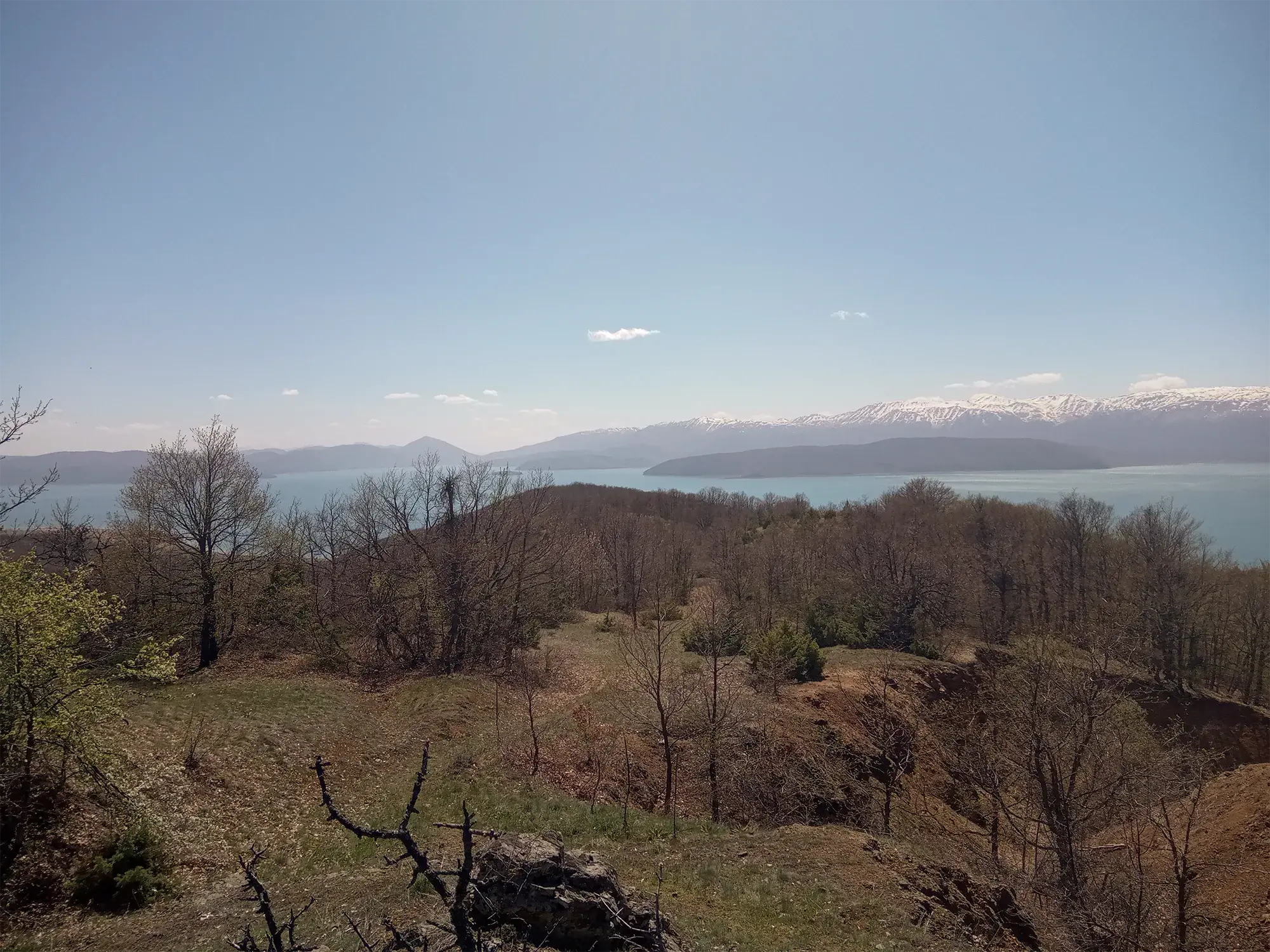
The landscape feels open in a way that's become rare in Europe. The lake extends 23 kilometers from north to south, with mountains rising on all sides: Galicica to the west, Baba Mountain to the north, the peaks of Greece to the south. The villages remain small. Stenje has about 200 permanent residents. The road that circles the lake sees little traffic outside summer weekends.
When to visit
Dalmatian Pelicans return to Prespa in late February. By mid-March, pairs have claimed nest sites and begun courtship displays: head tossing, bill clapping, synchronized swimming. Egg laying peaks in April. If you visit in early May, you'll see adults shuttling between the nests and fishing grounds, bringing back crops full of fish for chicks that are just starting to grow their second coat of down feathers.
The early morning hours between six and nine produce the best light and the most activity. Pelicans are active throughout the day, but they fish most aggressively after dawn. The air is cool, the lake surface smooth, and the birds haven't yet dispersed across their hunting territories.
June brings fledglings to the water's edge. Young pelicans spend weeks learning to fish effectively, and you'll see them practicing the cooperative herding technique that adults use. Their plumage is brown-grey, quite different from their parents.
July and August are hot. The reserve gets quiet during midday, though early morning and evening sessions still reward patient watchers. This is when birders from Western Europe discover they can have an entire observation tower to themselves on a weekday.
Autumn migration runs from late August through October. The number of species peaks during this window. Shorebirds use Prespa as a stopover on their journey from Arctic breeding grounds to African wintering areas. Raptors follow the mountain ridges: Honey Buzzards, Short-toed Eagles, Levant Sparrowhawks.
Winter transforms the lake. Most pelicans migrate to coastal Greece, but a small number stay if the lake doesn't freeze. The resident Pygmy Cormorants remain year-round. Flocks of waterfowl arrive from the north: Goldeneyes, Smews, and the occasional Red-breasted Merganser.
How to watch without disturbing
The observation towers exist for a reason. Approaching the reed beds on foot or by boat pushes birds off nests and exposes eggs or chicks to predators. The towers put you at eye level with pelicans in flight, about 50 to 70 meters from active nests, which is close enough for excellent views through binoculars while remaining far enough to avoid causing stress.
Bring 8x42 or 10x42 binoculars at minimum. A spotting scope helps if you want to study plumage details or watch behavior at greater distances. Cameras need telephoto lenses in the 300-600mm range to capture frame-filling images from the towers.
Movement and noise carry across water. Fast movements, especially inside the towers, startle birds. Conversations at normal speaking volume don't seem to bother them, but shouting or playing music does. The reserve prohibits dogs, even on leashes, because their presence triggers alarm calls.
The dirt tracks to the towers cross private land in some sections. Farmers here raise sheep and grow wheat. Stay on the paths, close any gates you open, and don't pick plants or remove anything from the reserve. The local community supports conservation because it brings visitors who buy meals and rent rooms, but that support depends on visitors respecting boundaries.
Early morning in late April or early May gives you the best odds of memorable encounters. The pelicans are nesting, migrants are passing through, the weather is mild, and the light is perfect. But even on a random Tuesday in July, you'll see pelicans doing what they've done here for thousands of years.
What else can you visit in Prespa?
The lake sits at the heart of a region that preserved its traditional character because it sat on three borders and remained isolated. The villages around the shore, both in North Macedonia and Greece, have stone houses, narrow lanes, and Byzantine churches decorated with frescoes. Stenje, Konjsko, and Oteševo are tiny, quiet, and functional rather than picturesque in a self-conscious way.
The water is clean enough for swimming. Locals fish for carp, roach, and the endemic Prespa trout. Small tavernas serve lake fish grilled simply with lemon, along with bean stews, peppers stuffed with rice, and fresh salads. Prices remain reasonable because tourism here is light and genuine.
The road between Ohrid and Prespa crosses Galicica National Park, climbing to 1,570 meters at the pass. Pull over at the viewpoint and you'll see both lakes spread below you: Ohrid to the west, Prespa to the east. Galicica's limestone ridges host wolves, bears, and Balkan chamois, though you'd need to hike to see them.
After a morning watching pelicans, you can be swimming in Ohrid Lake by early afternoon, or sitting in a taverna in Stenje eating fried carp by the water. This is a region you measure in minutes and hours, not days of driving.
Your Invitation to the Pelican Paradise
Picture yourself in the main observation tower just after dawn in April. The light comes horizontal across the lake, turning the water silver-gold. A line of pelicans flies past at eye level, so close you hear the rush of air through their feathers. They circle once and land among the reeds with surprising grace for birds so large. One begins the guttural croaking call that signals a shift change at the nest. Its mate emerges from the reeds, stretches its wings, and lifts off to go fishing.
You're watching one of Europe's great conservation successes unfold in real time, in a place most field guides barely mention. The pelicans don't care whether you're there or not. They're simply living the way pelicans have always lived when given clean water, abundant fish, and space.
The observation tower is open. The pelicans are nesting. The lake is waiting.