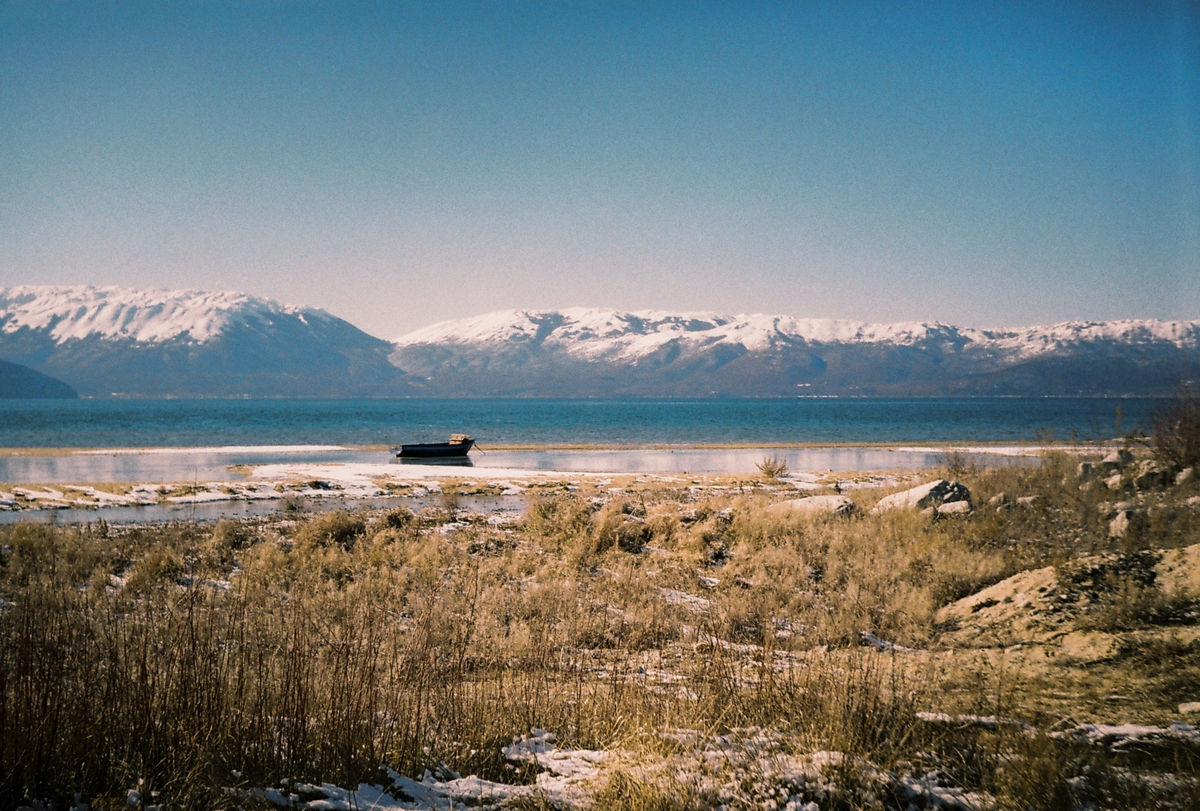
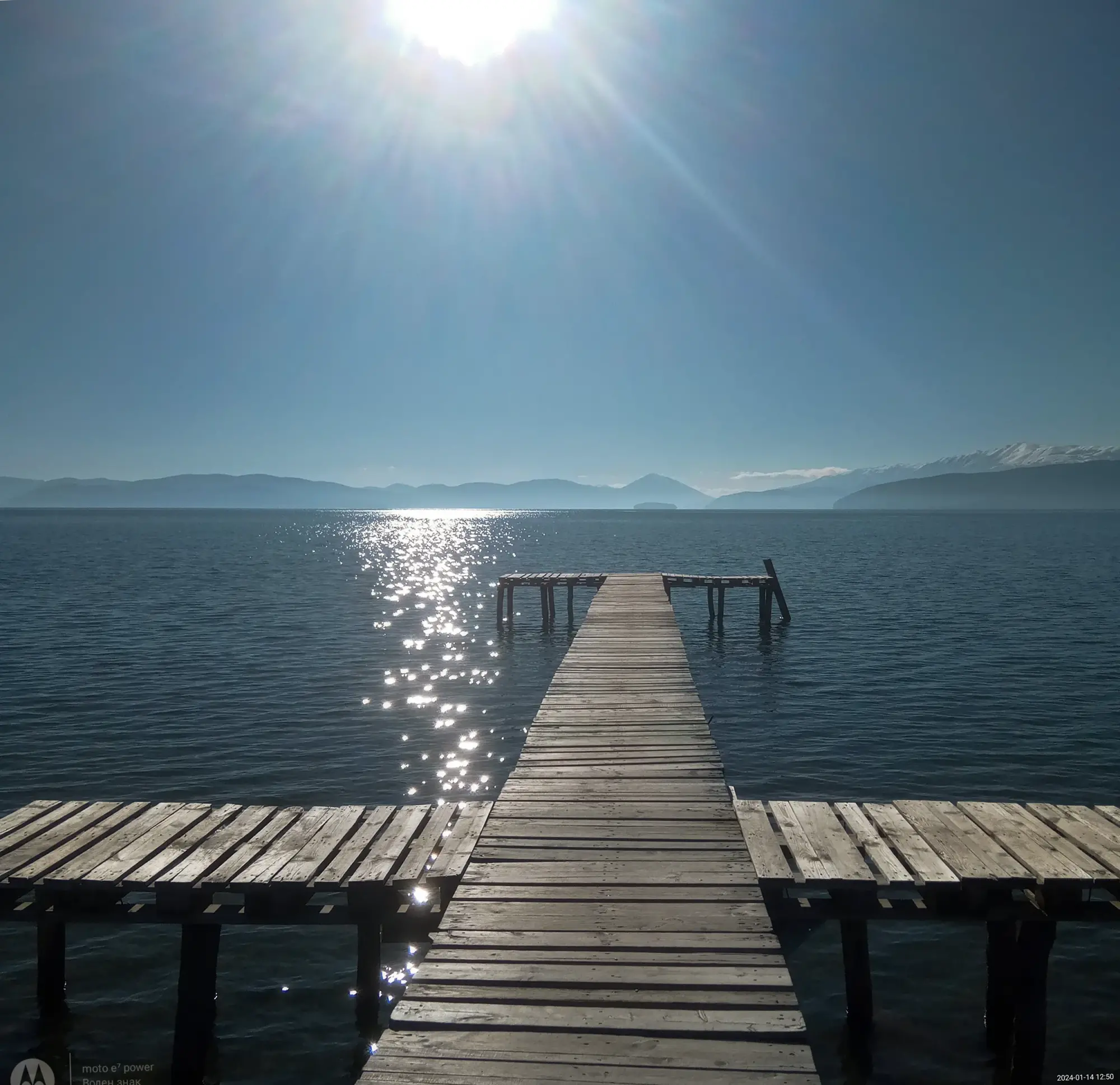
The boat rounds the southern point of Prespa Lake and the island appears. Rocky slopes rise about 30 meters above the water. Stone ruins stand on the highest point, walls and arches silhouetted against the sky. As the boat moves closer, the rocks seem to shift. Then you realize: those aren't shadows between the stones. They're snakes. Hundreds of them, coiled on sun-warmed limestone, draped over fallen masonry, sliding into crevices as the boat's engine disturbs their morning.
This is Golem Grad, and there's nowhere else quite like it in Europe.
What is special about Golem Grad?
The island covers 18 hectares in the southern basin of Prespa Lake, about four kilometers from the nearest shore. It sits within North Macedonia's waters but close enough to the Greek and Albanian borders that you can see both countries from its highest point. The entire island falls under the protection of Prespa National Park, established in 1999 to preserve the lake's unique ecosystems.
Two things make Golem Grad unusual. First, it hosts one of the densest snake populations recorded anywhere in the Balkans. Second, scattered across this snake-covered rock are the ruins of at least four Byzantine churches, the oldest dating to the 6th century.
The island serves as a breeding sanctuary for Dalmatian Pelicans. During nesting season, roughly 15 to 20 pairs build nests on the western shore, taking advantage of the isolation and protection from human disturbance. Pygmy Cormorants occupy dead trees near the water. Great White Egrets hunt in the shallows. The combination of archaeological sites, dense reptile populations, and active bird colonies creates something genuinely strange.
Are the snakes venomous?
Researchers estimate 15,000 to 20,000 dice snakes live on Golem Grad. That works out to roughly 1,000 snakes per hectare, one of the highest population densities recorded for any snake species in Europe. You'll also encounter grass snakes and occasionally Balkan whip snakes, but the dice snakes dominate.
Dice snakes are non-venomous, semi-aquatic colubrids that feed primarily on fish and amphibians. Adults reach 70 to 100 centimeters in length. Their scales are grey-brown with darker checkerboard patterning that gives them their name. They're completely harmless to humans, lacking both venom and aggressive temperament. When threatened, they flatten their heads to mimic vipers, release a foul-smelling musk, and sometimes play dead.
The island became a snake refuge because it offers everything dice snakes need: abundant frogs in the shallow bays, fish in the surrounding waters, endless basking spots on limestone rocks, and zero natural predators. The human structures provide additional habitat. Snakes nest in the gaps between foundation stones. They hunt along the old walls. They coil in the shade of Byzantine arches during the hottest part of the day.
Walk the island's trail and you'll see them constantly. Draped over rocks beside the path. Swimming through clear water near the shore. Disappearing into crevices as you approach. The first few encounters feel unsettling. By the end of an hour, you're stepping around them casually while your guide points out a particularly large individual sunbathing on a church foundation.
The guides carry sticks to gently move snakes off the trail when necessary. They'll tell you the same thing repeatedly: don't step on them, don't try to pick them up, give them space. The snakes will do the same for you.
Meet the pelicans and other birds
Dalmatian Pelicans nest on Golem Grad's western shore from March through June. The colony is smaller than the one at Ezerani but offers a different viewing opportunity. Here, you observe from the water as the boat circles the island. The pelicans build nests on low rocky platforms just above the waterline, using reeds and driftwood. During incubation and early chick-rearing, at least one adult stays at each nest while the other fishes.
The boat tour typically circles the island once before landing, giving you views of the nesting area from about 30 to 50 meters offshore. Pelicans in flight pass at eye level. Adults standing on nests are clearly visible through binoculars. If you visit in May, you might see grey-brown chicks large enough to stand but still downy and awkward.
Pygmy Cormorants perch in skeletal trees that died years ago but remain standing in shallow water. These small, dark cormorants breed in loose colonies, building stick nests in the branches. They dive for fish in the bays around the island. Great White Egrets stalk the shoreline. During spring and autumn migration, the island's position makes it a stopover for various raptors, including Short-toed Eagles and Levant Sparrowhawks, which use the thermals rising off the warm rocks.
Birdwatchers visit for the perspective. At Ezerani, you watch from shore as pelicans come and go. At Golem Grad, you're on the water with them, seeing where they rest between fishing sessions and how they interact with the island's other residents.
The history of the ruins
The Church of St. Peter stands on the island's highest point. Its walls rise about four meters, built from limestone blocks mortared with lime and crushed brick. The apse survives mostly intact. Inside, fragments of frescoes cling to the plaster: a section of drapery, part of a halo, unidentifiable figures worn by centuries of weather. Archaeologists date the church to the early Byzantine period, somewhere between the 6th and 8th centuries.
Three other church ruins scatter across the island at lower elevations. Some are just foundations. Others retain partial walls. The largest sits near the southern shore, its floor plan still clear: a basilica with three naves, apse to the east, narthex to the west. Wild fig trees grow through the masonry. Snakes nest in the rubble.
No one knows exactly why multiple churches were built on this small, remote island. The most common theory suggests a monastic community, possibly a retreat for hermits seeking isolation. Some historians point to evidence of earlier Roman occupation and suggest the island served as a refuge during invasions. Archaeological surveys have recovered pottery fragments, bronze coins, and other artifacts spanning from the Roman period through Ottoman times, indicating continuous or repeated use over more than a millennium.
You can walk around the ruins but not enter the church structures. The walls are unstable. The frescoes deteriorate with every visitor who brings in moisture and disturbs the microclimate. The trail loops past all major sites, with informational signs in Macedonian and English explaining what you're seeing.
The atmosphere is specific. Stone ruins overgrown with scrub vegetation. Snakes sliding through gaps in millennium-old walls. Pelican calls echoing off the rocks. Mountains visible in three directions across the water. It feels isolated in a way that's rare in modern Europe.
How to visit Golem Grad
You cannot visit Golem Grad independently. Access requires a guided boat tour, which serves both practical and conservation purposes. The island has no dock, no facilities, and no clear landing point without local knowledge. The guided requirement also controls visitor numbers and ensures people follow the rules that protect nesting birds and archaeological sites.
Tours depart from two villages: Stenje on the Macedonian shore and Konjsko on the eastern side of the lake. Book through local guesthouses, the Prespa Park information center in Stenje, or directly with licensed boat operators. Most guesthouses can arrange tours with a day's notice, sometimes on the same day if a boat is already scheduled.
A typical tour runs two and a half to three hours total. The boat ride from Stenje to Golem Grad takes about 30 minutes each way, depending on weather and boat type. You'll spend 60 to 90 minutes on the island itself, walking the trail loop with stops at the main ruins and viewpoints.
Tours usually accommodate six to twelve people per boat. Smaller groups use traditional wooden boats with outboard motors. Larger groups go in bigger vessels with inboard engines and covered seating. The price varies by season, group size, and operator, but remains reasonable by European standards. Expect to pay roughly what you'd pay for a two-hour guided walking tour in any European city.
Morning departures work best. The light is better for photography. Temperatures are cooler. Snakes are more active in the morning when they're warming up after the night. Pelicans fish most actively at dawn and return to nests by mid-morning. Tours run from April through October, with reduced frequency outside the peak summer months. High winds or thunderstorms cancel tours for safety reasons.
What to expect during the tour
The boat leaves from a small harbor, either the protected bay at Stenje or the fishing dock at Konjsko. Both villages are tiny, with a handful of houses, a taverna or two, and not much else. The boat heads south, following the western shore for a while before turning toward the island.
The ride gives you perspective on the lake's size. Prespa stretches 23 kilometers north to south, surrounded by mountains that rise 1,000 meters above the water. The shores are mostly undeveloped. You'll see a few farms, some reed beds, the occasional fisherman. The water is clear enough that you can see rocks on the bottom in the shallows.
As you approach Golem Grad, the guide starts pointing out features: the church ruins on the summit, the pelican nesting area on the western shore, the dead trees where cormorants roost. The boat circles the island once, staying offshore while everyone gets a look at the nesting birds. Then it lands on a rocky beach on the eastern side.
Getting off requires careful footing. There's no dock, just rocks and shallow water. Once ashore, the guide leads the group onto the marked trail. Within the first 50 meters, you'll see your first snakes. They're on the rocks beside the path. They're in the low bushes. They're crossing the trail. The guide will stop, point them out, and remind everyone to watch where they step.
The trail climbs gradually to the Church of St. Peter at the summit. Along the way, you pass foundation ruins, scattered column fragments, and walls slowly disappearing into the vegetation. The guide explains what's known about each site. At the church, you stop for 10 to 15 minutes while people photograph the frescoes through the openings and look out across the lake.
The descent follows a different path, looping past more ruins and eventually reaching the southern shore before cutting back to the landing point. Total walking distance is about 1.5 kilometers. The terrain is uneven but not difficult for anyone with basic mobility.
People move slowly, stopping to watch snakes, photograph ruins, or scan for birds. The guides adjust the pace based on the group's interest. If you're fascinated by the reptiles, they'll pause and explain behavior. If you're more interested in the history, they'll spend more time on the archaeological details.
What to bring and wear
Wear closed-toed shoes with good grip. The trail is rocky and uneven. You'll be stepping around snakes. Sandals or lightweight hiking shoes work. Boots are better if you have them.
Long pants help protect your legs from brush and sun. The island has little shade. Bring sun protection: hat, sunscreen, sunglasses. Carry water. There are no facilities on the island.
A camera is essential. The ruins photograph well against the lake backdrop. The snakes, once you get past the initial uneasiness, make striking subjects. Binoculars help for watching pelicans and other birds from the boat or from viewpoints on the island.
Leave any food in the boat. You won't want to set anything down on the ground anyway. Don't bring walking sticks or trekking poles unless you need them for mobility. The guides use sticks to move snakes, and having multiple people waving sticks creates confusion.
Children can visit if they're old enough to follow instructions and comfortable around wildlife. The snakes are harmless, but seeing thousands of them in one place overwhelms some kids. Guides won't take children under about seven or eight, depending on the child.
The trail isn't wheelchair accessible. The boat landing requires climbing over rocks. The paths are too uneven for wheelchairs or walkers.
What the experience is actually like
Golem Grad isn't comfortable. It's hot, rocky, and covered with snakes. The ruins are weathered and sometimes hard to interpret without explanation. There's nowhere to sit except on snake-inhabited rocks. You can't get a coffee or use a bathroom. That's the point.
This is a working conservation site that happens to allow carefully controlled visitor access. You're seeing an island where nature and history coexist without being sanitized or simplified for tourists. The snakes don't hide because you're there. The pelicans nest in view because they evolved to trust the island's isolation. The ruins remain unrestored because restoration would damage what makes them archaeologically valuable.
What you'll remember is the strangeness. Medieval stone walls. Ancient lake. Snakes everywhere, moving through ruins that predate most European cathedrals. Pelicans calling from nests built on the same shores where Byzantine hermits once prayed. Mountains on three sides, each belonging to a different country.
The boat ride back to shore feels different than the ride out. You've walked through something that doesn't fit easily into categories. Archaeological site? Nature reserve? Snake sanctuary? All three, occupying the same 18 hectares, each aspect making the others more remarkable.
Preparing to go
Contact the Prespa Park information center in Stenje to arrange a tour. They work with all licensed boat operators and can schedule departures based on your timing. The center is on the main road through the village, clearly marked.
Most Ohrid guesthouses and hotels can also arrange Golem Grad tours, usually for the following day. If you're staying in one of the Prespa villages, your host can connect you with a boat operator directly.
April through June offers the best combination of nesting birds, active snakes, and mild weather. September and October bring fewer visitors and still-warm temperatures. July and August are hot, but early morning tours remain comfortable.
The island is protected. The snakes are real. The ruins are genuinely old. You'll walk carefully, watch where you step, and see something that exists nowhere else: a place where medieval hermits once prayed, now home to thousands of snakes and some of Europe's most threatened pelicans, all coexisting on 18 hectares of limestone in the middle of an ancient lake.
The boat is waiting.